

At CRSI, we believe durable carbon removal can and should be integrated into many different sectors of society, from enhanced weathering to improve crop yields to marine carbon dioxide removal in coastal resilience efforts. As we explored different carbon removal integration opportunities, something stood out: there is a lot of early momentum in waste management.
In this blog, we explore why that is, who is involved, and what can be learned from five early examples of carbon removal in waste management processes.
A bit of context
Waste management includes a broad range of activities — more than we could cover in just this blog. Thankfully, we’re not alone in exploring the potential of various waste management CDR opportunities. The case studies we selected (listed below) are among the first integrated projects in their respective domains. Throughout our work, we spoke with project proponents to better understand the opportunities for and challenges facing CDR waste management integrations.

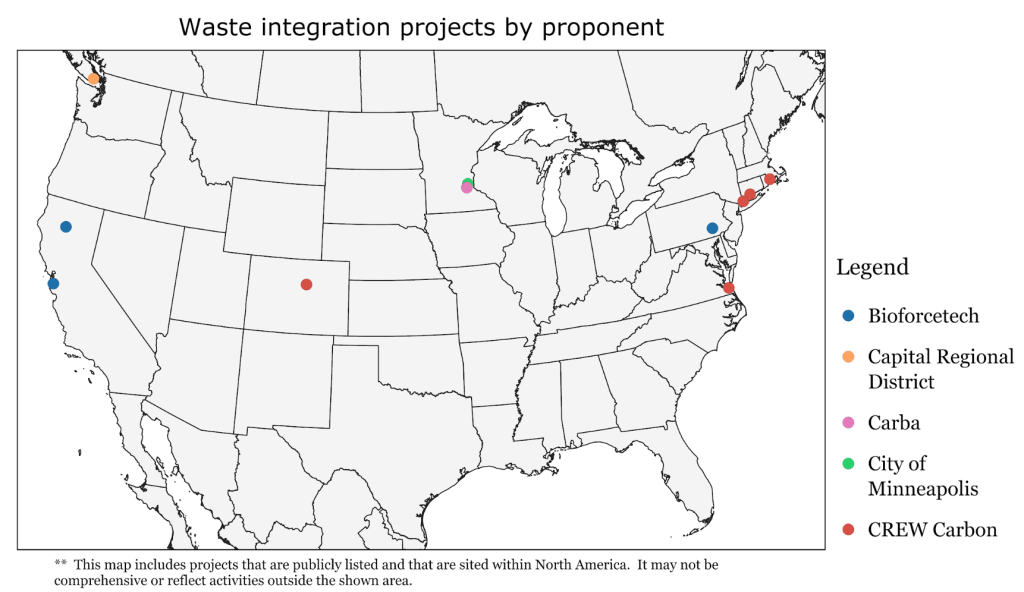
We think these examples illustrate three of the key features of CDR integrations in the waste management sector, specifically:
- How you find opportunities for CDR by solving existing problems
- How you match those problems and CDR solutions to the right policy support tools
- How you measure and report CDR outcomes for different stakeholders, including but not limited to generating carbon credits
Find: Carbon removal can solve specific waste management challenges
Many of the project developers we spoke with stressed that carbon removal was not creating co-benefits — it was the co-benefit. Across projects, there were three main environmental challenges being solved by carbon removal.
Excess wood waste created by invasive pests
Since the emerald ash borer, a non-native beetle, arrived in the United States in the 1990s, it has ravaged ash tree populations in the US East and Midwest. This extra wood waste creates a logistical nightmare. In Minnesota alone, there are estimated to be over one billion ash trees; in residential communities in the state, one in five trees are ash. When we spoke with Jim Doten, the Carbon Sequestration Program Manager for the City of Minneapolis, he noted the Twin Cities are experiencing a “wood tsunami,” in large part because of the emerald ash borer. Wood waste volumes are expected to peak in the area at over 500,000 tons per year in 2028. Already, the uptick has saturated local capacity.
This volume of waste is not handled monolithically. Biomass heat and power production currently absorbs ⅔ of the annual volume. Other disposal pathways including mulching, composting, and open burning account for much of the remainder, and are not particularly profitable. Biochar, by contrast, may offer relatively higher profitability due to carbon markets and its diverse potential use cases as a soil amendment. These attributes, in large part, compelled the City of Minneapolis to create North America’s first municipal biochar facility. The facility will pyrolyze approximately 3,600 tons of wood waste annually, meaning it is unlikely to fully displace any other method of disposal. However, the project represents an important test case for future replication.
Invasive pests are not the only source of wood waste in the Twin Cities. Carba uses wood from power line corridor trimming as one feedstock for their Burnsville project 14 miles outside of Minneapolis. Patricia Loria, Senior Vice President of Commercial at Carba said that pyrolyzing the waste for use in daily landfill cover is an economical alternative to some other disposal methods.
Wastewater treatment compliance
Wastewater treatment is getting more expensive. There are over 17,500 publicly owned treatment works (POTWs) in the US, which serve approximately 270 million people. The estimated cost of maintaining wastewater treatment infrastructure (which encompasses secondary and advanced wastewater treatment, along with stormwater management, water re-use, desalination, and more) over the next two decades has jumped to $630 billion, a 45% increase since 2016. Many factors are behind this price hike, including extreme weather effects as a result of climate change, maintaining and replacing old infrastructure, and rising costs of regulatory compliance. (The Environmental Protection Agency (EPA) also highlights that the recent report on costs is significantly more comprehensive than ten years ago.)
Discharge from point-source wastewater treatment in the US is regulated by the National Pollutant Discharge Elimination System (NPDES), a federal permitting program. One NPDES requirement is that wastewater discharge cannot be too acidic or alkaline upon being released back into the surrounding ecosystem.
Dr. Jo Katchinoff, CEO of CREW Carbon, likes to say that decarbonizing POTWs can be like trying to decarbonize hospitals—they both have high costs and such a critical function to society that decarbonization might seem tangential to their main objectives. CREW wants to change that by bringing decarbonization goals, cost, and regulatory compliance into alignment. The company doses crushed limestone into the wastewater treatment process to raise pH, as a substitute for more carbon-intensive additives like caustic soda and quicklime. At the correct rates, limestone addition can regulate pH while removing carbon beyond the baseline scenario, and the sale of carbon credits can offset additional costs.
Forever chemicals in biosolids
Effluent is only one product from the wastewater treatment process; biosolids are another main treatment output, with their own environmental challenges and carbon removal opportunities.
Biosolids are, in general terms, an end product of sewage sludge treated to comply with thresholds for contaminants and pathogens found in biological waste. In the United States, many potential pollutants are regulated for biosolids. Notably absent, however, are federal regulations on the concentration of PFAS and similar compounds, often called forever chemicals. This creates a huge issue for two reasons. First, forever chemicals have consistently been found in biosolids, and the wastewater treatment process does not remove them by default. Second, 84% of biosolids from monitored wastewater treatment plants in the US were either landfilled or applied to agricultural lands. In either case, those forever chemicals proceed to — and accumulate in — their application site.
As the name suggests, forever chemicals are hard to destroy. Heating the compounds to temperatures in the hundreds of degrees Celsius is one relatively well-researched option for breaking them up. Bioforcetech and treatment plants like Silicon Valley Clean Water in Redwood City, California are pyrolyzing biosolids into biochar, removing CO2 and eliminating forever chemicals in the process. The Capital Regional District is pursuing a similar approach.
In cases where biosolids are not pyrolyzed, they often end up in landfills. EPA data from 2024 suggests around 25% of biosolids in the US are landfilled. In cases where thermal destruction does not occur, Carba’s approach of adding biochar to daily landfill cover may help prevent forever chemicals from leaching into surrounding ecosystems.
Match: Policies and regulations can play diverse roles in supporting waste integrations
A wide range of policy tools can be used across levels of government to reach climate and environmental goals within waste management. We saw this diversity reflected in four types of support for waste management CDR projects.
Regulatory specs can incentivize CDR
In some cases, economically complying with existing regulatory needs can enable demand for CDR. The previously discussed example of CREW helping wastewater treatment facilities meet NPDES compliance fits this example well. Swapping limestone into the wastewater treatment process can enable wastewater treatment facilities to do more environmental good while meeting the same compliance standards.
In other cases, changing the specifications of a regulation can unlock opportunities for CDR. When speaking with Jim Doten, Program Manager for the City of Minneapolis biochar facility, he emphasized the importance of creating a viable end use for the biochar produced by the city. Without a way to use the biochar, moving the project forward becomes a lot harder. Here, Doten pointed to the possibility of getting biochar approved by the Minnesota Department of Transportation (MnDOT) for stormwater filtration on transportation corridors and street reconstruction. He added that obtaining MnDOT buy-in could drive biochar acceptance at all levels of government, from the state level and below. MnDOT approval can also drive specifications in the private sector, such as for engineers and architects. State-level approval can help enable end uses that work well in the local context.
City plans are a valuable driver for municipally run projects
Two of the five early mover projects discussed in this blog were led by municipalities: the City of Minneapolis and the Capital Regional District. In both cases, municipal plans played a clear role in the CDR integration process. Jim Doten noted the inclusion of biochar in both the 2023 Climate Equity Plan and Minneapolis 2040 Comprehensive Plan. Meanwhile, Liz Ferris, the Manager of Resource Recovery and Innovation at the Capital Regional District, highlighted the inclusion of biochar in the government’s Long-Term Biosolids Management Strategy. We think city and broader climate plans provide valuable legitimacy and context for the emerging programs. However, higher technology readiness level approaches like biochar might be more likely to be included in these kinds of plans, so it’s important to develop mechanisms that support a portfolio of novel CDR pathways.
State innovation programs can help finance new ideas
Bioforcetech and Carba both received financial support from state entities. In New York, Bioforcetech earned grant support from the New York State Energy Research and Development Authority; in Minnesota, Carba secured loan support from the Minnesota Climate Innovation Finance Authority.
It is also worth pointing out the role non-state actors can play in providing similar support. For example, a grant from Bloomberg Philanthropies Mayors Challenge provided $400,000 of support to the Minneapolis municipal biochar program. Grant support also helped the project gain visibility and attention as an early mover on a novel solution. The Mayors Challenge has provided similar support for municipal biochar in other cities, including Cincinnati, Ohio and Lincoln, Nebraska.
Federal policy can also provide valuable support to locally-implemented projects
Finally, two of these projects received federal policy support. Carba was selected as a recipient of the US Department of Energy’s (DOE’s) Carbon Negative Shot Pilots, which aimed to reduce the cost of durable carbon removal below $100 per ton. CREW was listed as a semi-finalist for the US DOE Carbon Dioxide Removal Purchase Pilot Prize. Currently, this prize is pending approval for continuation, and it is uncertain whether any of these DOE grants will be funded. This program facilitates offtake agreements, or guaranteed purchases, provided the ability to deliver credits and meet standards between the DOE and carbon removal companies.
The Carbon Negative Shot Pilots and the CDR Purchase Pilot Prize were part of a broader almost $15 billion in authorizations for carbon removal between fiscal years 2020 and 2026, highlighting the scale at which national governments can support solutions that solve local, but widespread, challenges.
Measure: Projects can serve different purposes, with different measurement implications
Of the five waste management integration projects reviewed in this blog, only two currently include generating carbon credits in their operating model. Those two companies, CREW Carbon and Carba, both work with Isometric, a private registry, and have both secured offtake agreements. Measurement of these projects is governed by Isometric’s protocols.
The Minneapolis biochar facility does not currently produce carbon credits, though the city is actively exploring the idea. Jim Doten explained the project is likely to produce approximately 1,000 metric tons of carbon removal per year; to make crediting the project more attractive, Doten noted the possibility of bundling credits across different municipal biochar projects.
Finally, the two biosolids pyrolysis projects included in this blog, Bioforcetech and the Capital Regional District, are not issuing carbon credits; instead, the projects rely on other mechanisms for funding. For example, Garrett Benisch, the Chief Development Officer at Bioforcetech, mentioned that Bioforcetech installations are purchased and operated by the municipalities; Bioforcetech offtakes the biochar at no cost and shares subsequent profit from its sale with the cities. For these municipalities, this approach lowers tipping fees and can be an overall more cost effective choice to business as usual.
But an important question remains: how will the carbon removal be counted for purposes beyond crediting?
There are a few options, depending on the end use. For products such as concrete with biochar as an aggregate, as is a use case for Bioforcetech’s OurCarbon, environmental product declarations track the carbon removal, lowering the global warming potential reported in the lifecycle emissions of concrete. Removals could also be reported in local, state/provincial, or national government inventories of greenhouse gas emissions. There is currently limited guidance on how to do this, but major initiatives like the Intergovernmental Panel on Climate Change are exploring how to better account for integrated CDR projects and ensure that climate-forward actors get credit for carbon removal activities.
A few concluding thoughts
There’s a lot going on with integrated carbon removal right now. Even within the waste management sector, this blog only scratches the surface. The five examples we reviewed in this blog are different from each other in many ways, yet three throughlines emerge.
First, integrated carbon removal is helping solve problems local communities already face, be it invasive pests, wastewater treatment, or PFAS remediation. Second, there is not a universal playbook to support these integrations; instead, a variety of tools including federal and state funding, municipal planning, philanthropic funding, and voluntary carbon markets can be deployed, depending on what fits best. And third, even within the (at first glance, narrow-looking) world of waste management carbon removal integration, measurement and accounting can serve quite different purposes.
This blog would not have been possible without valuable insights shared by representatives from each of the five case studies.
Garrett Benisch, Chief Development Officer, Bioforcetech
Patricia Loria, SVP, Commercial, Carba
Dr. Carly Anderson, Carbon Removal Scientist, Carba
Liz Ferris, Manager, Resource Recovery and Innovation, Parks, Recreation & Environmental Services, Capital Regional District
Jim Doten, Carbon Sequestration Program Manager, City of Minneapolis
Dr. Jo Katchinoff, Chief Executive Officer, CREW Carbon